
Pope Leo XIV on Monday underscored his commitment to spiritual advocacy over political friction, stating that he has no desire to engage in a confrontation with the US administration.

For weeks, the war skirted the edge of catastrophe without tipping over. Missiles flew, there was much destruction, commanders were assassinated, cities across the Gulf and even in Israel struggled to absorb the shock. But one line held: Energy infrastructure, the arteries of the global economy, remained largely untouched. That is no longer true. Prem Panicker continues his must read daily blog on the Gulf War.

...is a way out, notes Prem Panicker in his must read blog on the Iran War. What the indefinite extension produces is a prolonged condition of not-war-not-peace, in which oil markets cannot stabilise, Asian refineries cannot plan, European governments cannot stop subsidising consumption they cannot afford, and the next flashpoint -- a seized tanker, a miscalculated drone strike, a Truth Social post that claims too much -- is one news cycle away.

India and Russia are expected to sign a nuclear deal for the construction of four additional reactors at the Kudankulam nuclear power plant and expansion of other sites during Russian President Dmitry Medvedev's three-day visit to New Delhi beginning Thursday, a top official has said."We plan to sign on Friday an inter-governmental agreement with India to build another four reactors for the Kudankulam nuclear power plant, and envisaging cooperation," said a Russian official.

An Indian national sustained a minor injury in Abu Dhabi after debris from an intercepted ballistic missile fell in a residential area. Emergency teams responded to the incident, and authorities urged the public to rely on official sources for information.

The clock on the ceasefire is running out. But everyone's already whispering about round two, possibly as soon as this weekend.
More than 130 experts and non-governmental organisations from 23 countries have criticised the Ind0-US nuclear deal, saying its proposal to exempt India from the long-standing global nuclear trade standards "would damage the already fragile nuclear nonproliferation system and set back efforts to achieve universal nuclear disarmament".

The White House has responded cautiously to reports of Pakistan offering to mediate between the US and Iran, amid ongoing tensions and potential talks.

Israeli Prime Minister Benjamin Netanyahu announced a joint operation with the US against Iran, citing the threat posed by its nuclear ambitions and support for terrorism.

India's handling of the Iran crisis reflects a growing strain between strategic autonomy and geopolitical alignment, observes Ambassador M K Bhadrakumar.

An Indian national has died in Riyadh, Saudi Arabia, under unclear circumstances following recent events. The Indian Embassy is providing assistance to the family and liaising with local authorities.

US President Donald Trump asserted that the trade deal with India remains intact despite a Supreme Court ruling against his tariffs, while also claiming he used tariffs to stop a war between India and Pakistan.

'Our diplomacy should have been focused on preventing war and avoiding the inevitable disruptions it would cause, posing a real risk to India's growth story,' asserts former foreign secretary Shyam Saran.

Trump described the agreement as the "worst" and "one-sided transactions" that America has ever entered into.

For India, much is at stake: Crucial energy supplies traversing the Strait of Hormuz, the fate of its 10 million citizens living and working in West Asia -- who send generous remittances home -- and its major trade links with the region.

By all available indications, the White House drafted a face-saving note and handed it, ready-made, to Islamabad. Pakistani Prime Minister Shehbaz Sharif was supposed to then post it in the guise of a plea urging Trump to extend the deadline by two weeks 'to allow diplomacy to run its course'. Trump would then graciously accept Pakistan's 'request' and declare a ceasefire. Sharif dutifully posted the message on X. Except that he, or whoever was handling the account, forgot to delete the tell-tale first line visible in the edit history: 'Draft - Pakistan's PM Message on X'. Prem Panicker's must read blog on the Iran War.
Key provisions of the Indo-US nuclear deal.

PM Modi and his Japanese counterpart are likely to sign several agreements, including on civil nuclear cooperation. Both leaders are also likely to discuss defence cooperation, including joint maritime exercises between Japan, India and the United States.

The 'rescue' operation occurred within kilometres of Iran's underground tunnel complex at Isfahan, assessed by the IAEA and US intelligence as holding a substantial portion of the country's 60 per cent enriched uranium stockpile. Retired senior US military officers have highlighted that the mission's footprint -- hundreds of special operators, multiple heavy-lift aircraft deep inside Iran -- appears outsized for recovering a single airman. Prem Panicker continues his must read blog on the Iran War.
California representative Lantos was one of the key members of the Congress who were instrumental in getting the Henry J Hyde Act pertaining to the civilian nuclear initiative between India and the United States passed in 2006.
The India-Japan civil nuclear deal might not fructify anytime too soon, with Prime Minister Manmohan Singh acknowledging that India was keenly aware of Japanese sensitivities on the matter and "would not like to force the issue".

Iran launched retaliatory military strikes targeting Israel and American military bases across the region, including in Qatar, the United Arab Emirates, Kuwait, Bahrain and Jordan.
The president emeritus of Asia Society and former Kennedy administration official Phillips Talbot has said the nuclear agreement would benefit both countries as it would ensure strategic ties between Washington and New Delhi "for 20 or 30 years".

Backing New Delhi's quest for a permanent seat in the UNSC, Rouhani asked why India, a nation with population of 1.3 billion, was not a member of the powerful club.

'Much will depend on the position of the United States.' 'It will have to be seen to what extent the US will be more interested in achieving some form of a deal and to what extent Israel will be allowed to continue to carry out both airstrikes and the killing of Iranian officials.'
Menon will undertake a two-day visit from April 30 during which he will hold talks with US Under Secretary Nicholas Burns on the 123 agreement amid indications that Washington was 'frustrated' at the speed of the negotiations.

'What we have yet to see on either the US or the Iranian side is willingness to compromise on their ultimate demands and the flexibility to reach an agreement to end the war.

Rajya Sabha member Sudha Murty urges mandatory counsellors in schools to support children facing sexual offences during a debate on the Protection of Children from Sexual Offences (Amendment) Bill, 2024.

The purge in Washington does not pause the war. Strikes continue, Hormuz remains closed, and Brent crude is still dancing around $109 a barrel. For India, the command chaos in the Pentagon is another layer of uncertainty piled on five weeks of conflict that was already straining every buffer Delhi has.
Strongly backing the stalled civilian nuclear deal with India, Republican presidential candidate John McCain has said it would strengthen the US ties with the world's largest democracy and further involve New Delhi in non-proliferation efforts. McCain, 71, who has sealed the Republican nomination for the November Presidential elections, said the US should engage actively with both India and Pakistan to improve the security of nuclear stockpiles and weapons materials.

US President Donald Trump will travel to China in May for a rescheduled summit with Chinese President Xi Jinping, following a postponement due to the war in Iran. The White House has announced the new dates and indicated a reciprocal visit to Washington DC is planned.

Iranian Foreign Minister Seyed Abbas Araghchi on Saturday criticised the United States over its stance on Russian oil, claiming Washington was now "begging" countries across the globe, including India, to purchase Russian crude.
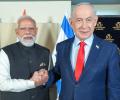
The Congress party has criticised the Indian government's diplomatic strategy, claiming a 'severe setback' if reports of Pakistan mediating between the US-Israel and Iran are accurate. The party alleges Pakistan's diplomatic engagement has surpassed India's, despite military successes.
The two countries are aiming at sorting out differences particularly on issues like reprocessing right, perpetuity of fuel supplies and continuance of the civilian nuclear cooperation if India were to conduct an atomic test.

The ceasefire is still technically holding, to the extent that no overt hostilities have been reported yet, but the rhetoric has hardened dangerously. The week ahead will also clarify whether the Islamabad failure was a negotiating tactic or whether Washington has genuinely locked itself into a position from which the only exits are climb-down, escalation, or the slow bleed of a new status quo that nobody chose and nobody controls. Prem Panicker continues his must read blog on the Iran War.
India's actions on nuclear deal contingent on US actions

Indian and American experts on Wednesday held detailed discussions on a range of implementation issues, including administrative, liability, technical and licensing matters to advance the operationalisation of Indo-US civil nuclear cooperation that has been in limbo for past 9 years.
